Trump Considers $21 Billion for Sunnyside Yard Housing as Mamdani Makes the Pitch
Federal largesse for New York’s Sunnyside Yard could reshape the city’s fortunes—and test America’s appetite for urban boldness.
On a damp February morning, as most New Yorkers navigated rush hour beneath sullen skies, Mayor Zohran Mamdani and President Donald Trump assembled in a windowed White House conference room to discuss a sum that exceeds the annual budgets of several US states: $21 billion, dangled as potential federal investment in the long-contemplated Sunnyside Yard housing project in Queens. For a city where the word “unaffordable” underpins countless conversations—from dim walk-ups in Flushing to glossy towers in Hudson Yards—the scale and symbolism are hard to ignore.
The meeting, held on February 26th and notably absent from the mayor’s public schedule, marked the pair’s second recent sit-down. This time, the pitch was unmistakably grand. At stake: building what officials tout as the “world’s largest deck” atop America’s busiest rail yard, thereby unlocking 12,000 new affordable homes—half modeled on the city’s beloved Mitchell-Lama program—plus schools, clinics, parks, and, not incidentally, an estimated 30,000 union jobs.
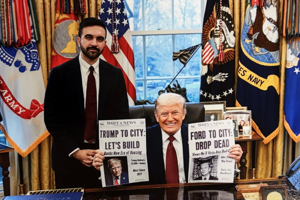
The city’s rhetoric is portentous: a “once-in-a-generation opportunity” to grapple with the housing crunch at real scale. Proponents cast it as the single largest housing and infrastructure injection in New York since the urban renewal drives of the 1960s. The mayor came armed with props—front pages of The Daily News, one emblazoned with President Ford’s infamous 1975 rebuff (“Ford to City: Drop Dead”), the other a mock-up championing Trump as a generational builder (“Trump to city: let’s build”). It is tough to resist the symbolism.
Yet beneath the bravado lies a wealth of complications and consequence. Should the $21 billion materialize, the city would abruptly gain the wherewithal to reverse some recent housing misfortunes: more than 70,000 people remain in municipal shelters, rents persist at record heights, and working families are increasingly priced out of the boroughs they supported for generations. A vast new neighborhood, built in one coordinated shot rather than piecemeal, could shift the dynamics of affordability—if, and it is a towering if, the plan survives regulatory gantlets that have entombed previous megaprojects.
The proposal’s economic implications for New York border on gargantuan. A deck atop Sunnyside Yard echoes Hudson Yards’ costly feats of engineering, but made explicitly for those without Wall Street bonuses. Direct construction could buoy local unions and small businesses for a decade; new residents may accelerate retail and transit demand. Supporters hope that a single city-sized investment might anchor surrounding property values and seed a public-goods renaissance in western Queens.
Nonetheless, there are formidable second-order concerns. Past city promises of affordable housing often delivered diluted results. The original Sunnyside Yard scheme, sketched during Bill de Blasio’s mayoralty, carried a more modest $14 billion price tag and stalled amid opposition from local activists, wary of “neighborhood character” or displacement. Community input, regulatory review, and NIMBY headwinds will still determine the project’s fate. New York’s infamous permit labyrinth—blending city, state, Amtrak, and federal fiefdoms—rarely moves briskly. Unless City Hall secures rock-solid labor standards and shields against speculative real estate gamesmanship, the vision risks joining other grand municipal unrealized dreams.
Politically, both the mayor and the president seek to don the hardhat. Mr Trump, Queens-born and famously devoted to visible monuments, may see in Sunnyside a chance to humble Washington’s gridlock and outdo his predecessors. For Mamdani, still early in his tenure, brokering federal billions would burnish credentials as a problem-solver, even as skepticism about “transparency, fiscal responsibility and collaboration” remains widespread. The city’s record—Exhibit A, the lacklustre Gateway Tunnel—invites caution.
A national test for urban ambition and American politics
In a national context, the scale and purpose of the Sunnyside scheme would be rare. While recent federal budgets and the Biden administration’s infrastructure push have bolstered subway lines and patched roads, outright federal generosity for new public housing has all but vanished since the 1970s. New York’s proposal, therefore, portends a partial revival of postwar American urban ambition—akin to the original Penn South or even Stuyvesant Town, albeit turbocharged by the era’s acute affordability anxiety.
Globally, New York’s struggles are not unique. Tokyo, Singapore, and Vienna have long shown what can be accomplished with political will, agency coordination, and capital: thousands of non-market flats, built efficiently and, crucially, distributed by need rather than luck. The difference is less technical than philosophical—a willingness to make huge bets on urban density and public provision, rather than perpetual tinkering.
Yet New York is not Vienna, and American federalism rarely rewards big-city plans. Will Congress, so recently addicted to handwringing over deficits, consent to such largesse for a blue-leaning metropolis? Will a new influx of affordable homes meaningfully dent rent inflation or merely trigger fresh rounds of local opposition? The answers will reveal much about the country’s appetite for urban policy experimentation, as well as the interplay between presidential ego and municipal necessity.
We reckon the risks here are undeniable, not least of financial overrun and bureaucratic sclerosis. Yet, bolder than a thousand incremental rezonings, a Sunnyside Yard project executed with genuine transparency and citizen buy-in could be the catalyst for similar investments in other struggling urban bastions. New York’s housing impasse, more than a product of bad luck or feeble regulation, reflects a chronic paucity of scale and vision.
For a city accustomed to inertia—where housing debates routinely pit neighborhoods against newcomers, and lofty plans are diluted to mediocrity—a federal partnership of this magnitude bodes well. The challenge is not merely to build, but to do so swiftly, affordably, and equitably. Should Mr Mamdani and Mr Trump thread this needle, their unlikely bargain may yet set a sturdy precedent in a country more attuned to gridlock than grandeur.
A city that can still surprise itself, and the nation, with its ability to build boldly might just recapture some of the optimism that once made New York a lodestar for urban modernity. The stakes are puny for no one. ■
Based on reporting from www.qchron.com - RSS Results of type article; additional analysis and context by Borough Brief.