Latina Nurses Take Lead in NYC Primary Care, System Still Trails on Equity and Prevention
As New York’s primary care shoulders an ever-rising load, a dearth of Latino nurses signals challenges for both equity and effectiveness.
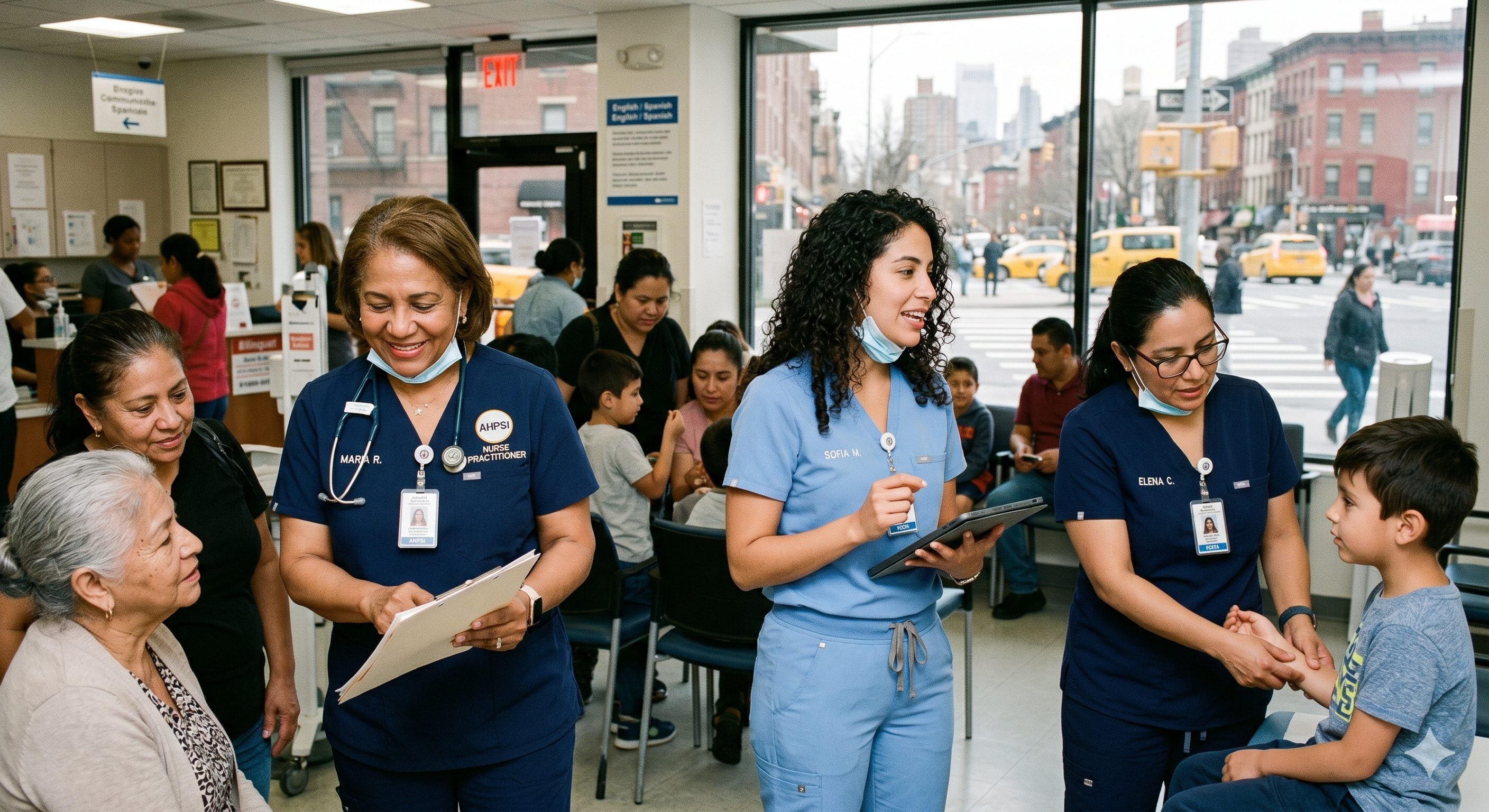
On the Monday morning rush at Elmhurst Hospital in Queens, the waiting room is a panorama of New York’s diversity—a throng of recent immigrants, elderly locals, and neighbourhood stalwarts, many speaking Spanish or Mandarin rather than English. At the centre of this orchestrated chaos is not a doctor, but a nurse, deftly triaging patients, fielding anxious questions, and acting—in a pinch—as interpreter and confidante. Welcome to the emerging reality of primary health care in America’s largest city: increasingly nurse-powered and, increasingly, stretched to its limits.
The New York Health Foundation’s latest analysis offers little comfort to those eyeing the city’s primary care apparatus. Barely 3% to 5% of the state’s health spending flows into primary care, a paltry figure compared with the 10-12% benchmark recommended by experts. Instead, the health system spends lavishly on hospitals and emergency departments—an inversion that bodes ill for prevention, efficiency, and equity alike.
In this lopsided regime, nurses have become indispensable. Particularly in low-income boroughs and immigrant-heavy enclaves, nurse practitioners and registered nurses (RNs) now perform duties historically reserved for family physicians: chronic disease management, preventive screenings, and much of the first-line triage. The city, which now counts around 29% of its population as Latino, has come to rely on these professionals as the scaffolding of its overtaxed clinics and community health centres.
Yet the labour force bears little resemblance to the patients it serves. Data from city hospitals reveal that a mere 8% of nurse practitioners identify as Hispanic or Latino—a profound mismatch in a city where nearly one in three residents can trace roots to Latin America. Nationally, the gulf is wider still: only 4% of registered nurses self-describe as Latino, according to the most recent surveys.
Behind the numbers lie quieter, structural barriers. Dr. Arítmedes Restituyo, who heads the Hispanic Association of Health Professionals in New York, New Jersey, and Pennsylvania, notes that many foreign-trained nurses find licensure nearly unscalable. “We see highly skilled nurses from Colombia, the Dominican Republic, and elsewhere, cleaning houses or working in home care, not because they lack skill, but because the certification processes remain dauntingly opaque,” he says. New York and New Jersey have chipped away at some of these hurdles, but progress is slow and demand keeps rising.
The costs of this mismatch reverberate across neighbourhoods. In predominantly Latino districts—from the South Bronx to Sunset Park—the shortage of culturally and linguistically concordant clinicians undermines care at every turn. Patients struggle to describe symptoms, misunderstand discharge instructions, and—crucially—lose trust in a system they already view with suspicion. The minority of Latina nurses in the system serve double duty: not just hands-on medical care, but bridge-builders, informal translators, cultural interpreters, and—too often—intermediaries between wary families and institutions.
For city health planners, the implications are stark. A saturated network that leans so heavily on nursing while underinvesting in both recruitment and training risks compounding existing inequities. The city’s vaunted diversity portends not just opportunity but obligation: culturally competent primary care that meets communities where they are, delivered by clinicians who look and speak like their patients.
Bridging the care and cultural gaps
Looking beyond city limits, New York’s dilemma mirrors a nationwide bind. Across America, the nurse workforce is ageing, shortages in disadvantaged areas are mounting, and the demand for language-concordant care far outstrips supply. The city’s distinctive diversity—with neighbourhoods that rival many Latin American capitals in population and density—makes these mismatches notably acute. Yet New York’s failure to align its workforce with its demographic realities should be seen as an instructive warning for cities from Houston to Los Angeles.
More optimistically, the profession’s evolution carries some promise. State legislatures in Albany and Trenton have begun to ease licensing for foreign-trained nurses and to invest (albeit modestly) in local training pipelines. Nationally, there are stirrings of interest in more creative approaches—loan repayment schemes tied to work in high-need communities, expansion of “nurse practitioner” scope-of-practice laws, and greater recruitment from underrepresented groups.
Other advanced countries suggest what could be feasible. In Canada, Britain, and Australia, explicit investments in primary care, welterweight credentialing pathways for foreign health workers, and targeted scholarships have all led to nurse workforces better matched to local demographics—and care systems that are more preventive, less crisis-driven, and cheaper over the long haul.
But rhetoric nearly always outpaces reform. For every step taken, obstacles remain: tortuous certification requirements, patchwork funding, and politicians wary of antagonising professional guilds. The risk is inertia—the steady sapping of workforce capacity while patient needs mount and system costs balloon. The result, already visible in New York’s most underserved boroughs, is a reliance on nurses stretched dangerously thin, expected to cure not just pathologies but systemic limitations.
Ultimately, the city’s experience offers a parable: that a modern metropolis, no matter how dynamic, cannot treat primary care as an afterthought or ignore the chasms between caregivers and those they serve. Providing bridges, linguistically and culturally, is not mere social engineering but hard-headed public health. Robust policy—demanding investment, streamlined certification, and active recruitment—is less utopian than utilitarian.
The stakes are hardly abstract. New York’s experiment with nurse-driven care is poised to expand, by necessity if not by design, as budget pressures and doctor shortages collide. The degree to which this trend bolsters—not merely props up—quality and equity will depend on whether the city marshals the political will to invest in the right caregivers, armed with the skills and perspectives that its modern-day populace demands. Left unaddressed, the present alignment portends a future of primary care that is both over-reliant and underprepared.
If America’s gateway city cannot build a primary care workforce that reflects and understands its burgeoning diversity, one wonders who can. For now, New York’s overburdened nurses persevere—patching gaps, translating needs, and carrying a system as vital as it is vulnerable. ■
Based on reporting from El Diario NY; additional analysis and context by Borough Brief.