Far Rockaway Tops Out 90-Unit Supportive Housing, Solar Arrays and Sly Hope Included
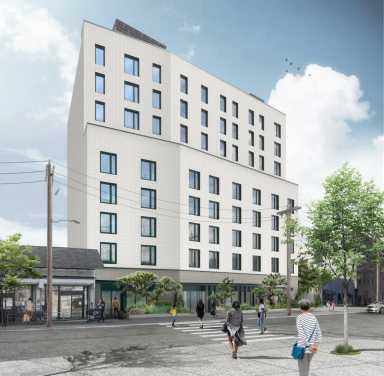
An energy-efficient, community-focused housing project in Far Rockaway spotlights the complexities of addressing New York’s affordable housing shortfall.
When it comes to affordable housing in New York City, the numbers rarely astonish in an uplifting sense: by the city’s own estimate, over 70,000 New Yorkers sleep in shelters on any given night. Amid this grim statistic, the recent topping out of a modest, 90-unit building at 19-19 Cornaga Avenue in Far Rockaway merits attention. Anodyne though this milestone may seem, the structure represents a small but telling experiment in mitigating the city’s chronic housing stress, especially among some of its most vulnerable residents.
The building, a nine-storey edifice clad in pale paneling and black-framed window grids (courtesy of Paul A. Castrucci Architects), is a joint venture between PMG Affordable and Brisa Builders Development. Around two-thirds of its apartments are reserved for that often-overlooked cohort—young adults aged 18–25 who have aged out of the foster care system, along with families in urgent need. Twenty additional units will be distributed through the city’s affordable housing lottery, a process famed for both its impartiality and its statistical unlikelihood.
Set to open by the end of 2026, the complex will offer more than simply shelter. Its 65,000 square feet will host a ground-floor community facility, discounted for nonprofits dispensing educational, medical, or professional services. There will be an attended lobby with security, computer and laundry rooms, bike storage, a children’s play area, and even a fitness centre—niceties that, in some neighbourhoods, remain aspirational.
In a nod to environmental realities, the building’s mechanicals eschew gas for electricity, employ energy recovery ventilation, and flaunt a rooftop solar array. All lighting is high-efficiency LED, and apartments are equipped with EnergyStar appliances and eco-friendly finishes. Whether these features portend meaningful energy savings in the real world—or merely make the building more palatable to grant-making committees—remains to be seen.
On a practical level, the development offers a rare lifeline to “transition-age youth”—those who, upon leaving foster care, frequently tumble straight into homelessness. Few policies have so consistently failed as the American foster care-to-housing pipeline: within eighteen months of emancipation, nearly one-quarter of former foster children in New York are homeless, according to the city’s Administration for Children’s Services. That the Cornaga Avenue complex will house sixty such individuals hints at both the scale of their need and the city’s inadequate response.
Yet optimism must be tinged with realism. Ninety new units, even equipped with the full panoply of communal amenities, are puny relative to the scale of the city’s affordable housing deficit. The mayor, Eric Adams, trumpets bold plans for 500,000 new homes by 2032—a target that, as with many prior city goals, seems destined to slip. Construction starts for affordable and supportive housing are down by double digits this year, thanks to tangled permitting, fickle financing, and the inertia of local politics.
The second-order effects ripple far beyond the tenants themselves. Developments like 19-19 Cornaga Avenue are one mechanism to stave off the cyclical burdens of intergenerational poverty and the societal costs that accrue with it—from poorer health outcomes to higher rates of incarceration. Moreover, by toggling rents and reserving units for at-risk youth, such projects offer a faint bulwark against further fraying of what remains of New York’s civic fabric.
From an economic perspective, the integration of ground-floor community space—discounted for service providers—suggests an attempt at a broader model: turning housing complexes into nodes of support, not just warehouses for bodies. The social services office, to be staffed by Not On My Watch, Inc., is a test-case of this “housing plus” paradigm. The logic is sound: without ready access to education, job training, and mental health care, even the best-built affordable unit can become a revolving door.
A modest push against a gargantuan deficit
Cities from Los Angeles to London are pursuing variants of this “supportive-plus-sustainable” housing model, signalling a growing consensus that bricks and mortar alone do not suffice. Yet nowhere do the stakes loom quite so large as in New York, where rising construction costs, regulatory bottlenecks, and land scarcity conspire to hamstring the housing supply. Against this backdrop, Far Rockaway’s project is a microcosm of both the promise and limits of public-private collaboration.
Notably, the project’s green credentials—plastered across press releases and architectural renderings—seem less an expression of true Yankee ingenuity than a nod to city-mandated energy targets. New York, like many metropolises, is eager to burnish its environmental bona fides, but questions remain about the trade-offs between up-front sustainability features and the imperative to create as many units as possible.
Compared to recent supportive housing efforts in cities such as Houston or Seattle—where the focus is more squarely on scale—New York’s incrementalism may seem equivocating. Still, the integration of young people aging out of foster care stands out: few American cities have attempted such targeted prioritization within high-cost new builds, either for want of funding or lack of political will.
What, then, does the Cornaga Avenue building portend for New York’s broader housing malaise? While admirable as a template for combining environmental and social ambitions, its minuscule scale renders it a mere drop in the bucket. The city’s housing lottery regularly draws over 60 applicants per unit; even if dozens of such projects were replicated, the wait would be Sisyphean.
And yet, to dismiss experiments like this as quixotic would be to ignore incremental progress—often the only kind New York can muster amid its famously intricate politics, paltry land supply, and ageing infrastructure. The real test may be whether city officials can systematize pilot projects of this stripe, scaling them up in ways that survive budget cycles and electoral turnover.
In the end, 19-19 Cornaga Avenue is more a symbol than a solution: a thoughtfully-appointed building, modest in ambition, that offers 90 households a foothold in a city that too often claims to welcome all, but houses only some. As New York’s housing crisis grinds on, such symbols may become both more frequent—and more necessary—than City Hall would care to admit. ■
Based on reporting from QNS; additional analysis and context by Borough Brief.