Delaying Climate Law Could Withhold Billions From Bronx to Sunset Park Energy Bills
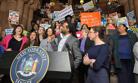
Delaying New York’s landmark climate law may leave the city’s most vulnerable residents to foot the bill—as the economics of energy and equity intersect.
On a swelteringly humid July weekend, many New Yorkers are likelier to seek solace in an air-conditioned subway car than to parse the intricacies of climate policy tucked into the state budget. Yet, as state lawmakers wrangle over Governor Kathy Hochul’s proposal to delay the 2019 Climate Leadership and Community Protection Act (CLCPA), the abstractions of carbon pricing collide directly with the wallets and well-being of the city’s Black and Latino residents. Behind the jargon, billions of dollars, and a fundamental question: who pays for New York’s energy transition—and who benefits?
Passed with fanfare five years ago, the CLCPA set some of the nation’s most ambitious decarbonisation targets: a 40% reduction in greenhouse gases from 1990 levels by 2030, and net-zero emissions by 2050. Its lynchpin is the so-called “cap-and-invest” programme, compelling major polluters to buy permits for their emissions. The proceeds—an estimated $3-5 billion in the first year alone, according to state analyses—are earmarked for community investments, notably in neighbourhoods state officials designate as “disadvantaged.”
Under the letter of the law, at least 35% of that revenue flows directly to these communities—encompassing most of the Bronx, Harlem, broad swathes of central Brooklyn, Sunset Park, Red Hook, and working-class strips of Queens. The logic is not subtle: New York’s grid, roads and aging infrastructure routinely expose these areas to higher rates of pollution and heat, whilst their residents bear a disproportionate share of the city’s energy poverty.
Critics, including advocates and some lawmakers, contend that Governor Hochul’s proposed delay in implementation—originally motivated by cost concerns amid inflation and surging energy prices—would withhold as much as $21 billion over several years from neighbourhoods that most need it. Those funds, had they flowed as planned, would have subsidised home weatherisation and rooftop solar installations, and covered rebates for households struggling with high utility bills.
Recent numbers give their arguments teeth. According to Robin Hood Foundation’s Poverty Tracker, two in five New York City residents have fallen at least two months behind on their energy bills. One in four has had service cut off. The burden falls heaviest along racial lines: Black and Latino families are over twice as likely as whites to be behind, and nearly eight times as likely to see a shut-off.
The CLCPA, as written, would aim to provide immediate relief—a projected average of over $8,500 in bill rebates for households earning less than $200,000, in addition to longer-term upgrades for energy efficiency. New York would not only be fighting climate change, but cold apartments, aging radiators, and envelope-pushing ConEd bills.
For now, that prospect remains in flux. Governor Hochul’s team argues that the delay is prudent fiscal management, cautioning against rate spikes and consumer backlash. She points to escalating cost-of-living pressures, wary of handing the opposition a cudgel ahead of difficult elections. Utilities—ConEdison, National Grid, and their peers—lobby in quiet relief, spared for now the up-front costs of compliance and capital upgrades.
The result is a tepid political compromise. In the short term, the state risks letting private utilities continue to pass on costs through rising rates or late fees, rather than redirecting money to public investments. The climate plan’s economic jolt—particularly for public housing blocks mired in neglect—has been deferred for yet another legislative cycle.
Climate politics in a crowded city
Yet the stakes transcend the next Albany session. New York has long been a laboratory for environmental policy. Its choices frame not only the city’s smoggy horizon but also the broader conversation about “just transition”—the principle that climate adaptation and decarbonisation must not leave the poor or marginalised behind. The state’s approach is more ambitious than most: channel polluter fees not to general coffers, but to zip codes mapped by historic disadvantage.
Nationally, debates over climate investments reveal a familiar pattern. States from California to Massachusetts have struggled to balance the imperative for rapid emissions cuts with the risk of political fallout from higher energy prices or job losses. Federal efforts, through the Biden administration’s climate law, make similarly optimistic promises of green jobs and affordable transition, but often with modest specificity about distributional impacts.
New York’s cap-and-invest plan, for all its imperfections, offers one of the more pointed attempts to socialise environmental costs and benefits. Skeptics bristle at the heavy hand of state intervention and complain of bureaucratic inertia, but the scale and targeting of potential funding—billions reserved for the city’s churning mosaic of working-class communities—are hard to match.
Of course, policy is often measured not by intent but by outcomes. Without aggressive implementation, the risk is that ambitious benchmarks become another layer of unmet promises, fueling political cynicism and eroding public support for climate action. Recent delays serve as a case in point: for residents in South Bronx or East New York, pronouncements from Albany matter little if their ConEd bills continue to climb.
Still, the model is instructive. Successful climate action in crowded, diverse cities like New York requires both technical sophistication and political discipline. More importantly, it demands a recognition that headline targets will founder without reckoning with affordability and equity head-on.
For now, New York teeters between boldness and timidity—balancing on the rhetorical high-wire between fiscal caution and climate ambition. The longer policymakers dither, the more likely that historical inequities—pollution, disinvestment, exclusion from new green industries—will be reinforced, not redressed, by the impending transition.
For all the Sturm und Drang at press conferences and on Senate floors, the calculation is starker for those in upstate boardrooms and Brooklyn basements alike: Public policy delayed is public investment denied. As the climate clock ticks, the city’s long-suffering residents may well wonder whose time—and money—will finally come. ■
Based on reporting from City & State New York - All Content; additional analysis and context by Borough Brief.