City Floats 12,000-Home Queens Build Over Sunnyside Yard, Dreams of Space at a Premium
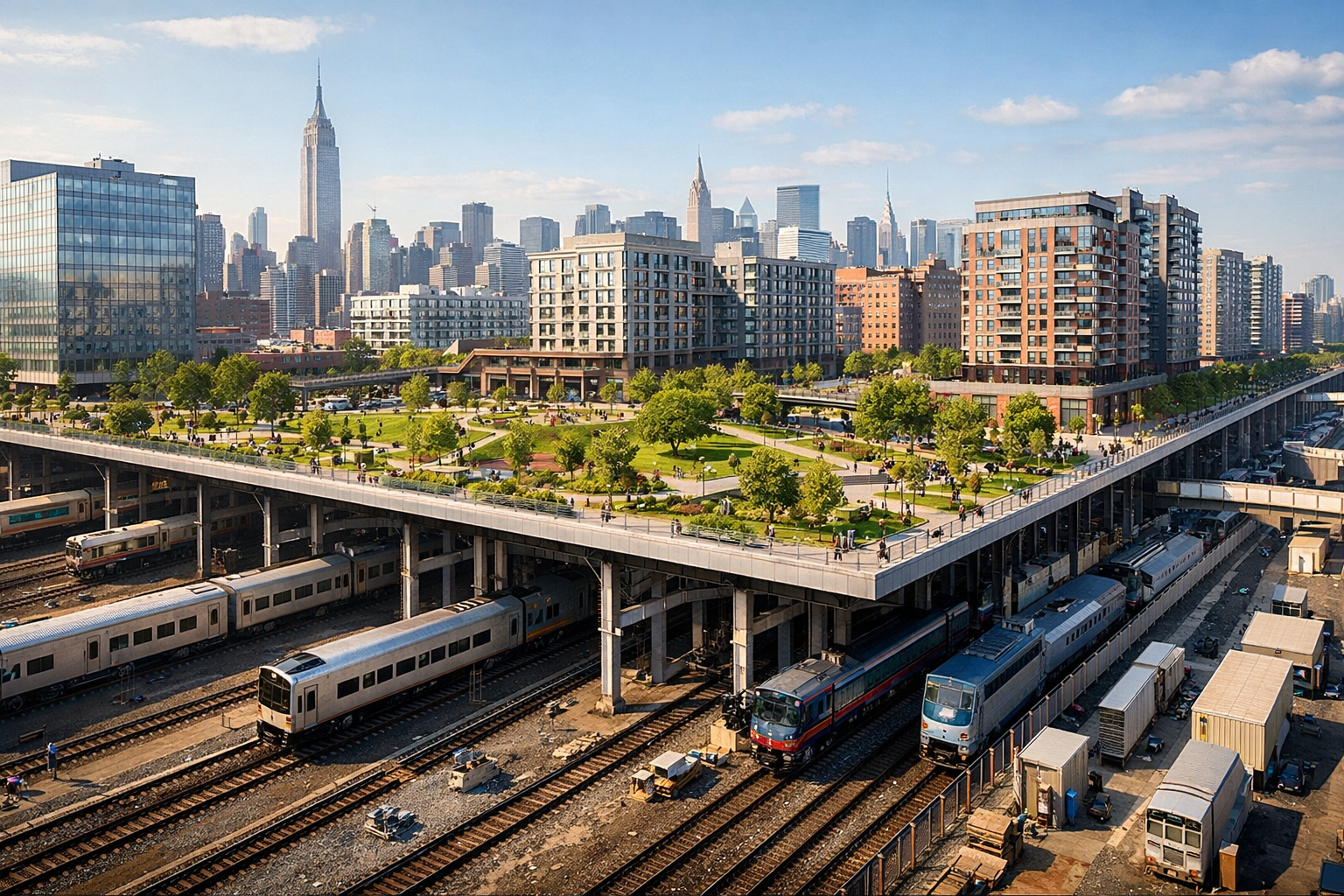
As New York faces a persistent housing crisis, a gargantuan plan to build a new district atop Sunnyside Yard’s tangled rail lines may portend a new era of urban reinvention.
For most New Yorkers, crossing Sunnyside Yard in Queens is a thought experiment at best. The 180-acre expanse, threading through Long Island City, Sunnyside and Woodside, comprises a jumble of steel rails, commuters, and idle locomotives. A century-old engine room for Amtrak, Long Island Rail Road, and New Jersey Transit, it has long divided neighbourhoods while stubbornly refusing any hint of gentrification. Now, City Hall and urban planners want to smother its tangle with a monumental platform, lay out boulevards, and, not incidentally, create a new “neighbourhood in the sky.”
The plan, advanced by Council Member Zohran Mamdani and discussed in both city and White House circles in recent weeks, would see tens of billions of dollars invested over decades. In its boldest telling, the scheme supports construction of 12,000 apartments—many promised as affordable—plus schools, libraries, parks and space for commerce and community. If built, it would rival the last great wave of New York urban development in the 1970s and eclipse the more recent, glassy Hudson Yards.
What propels this megaproject, of course, is the city’s acute housing crisis. With vacancy rates in the five boroughs scraping all-time lows and rents rising faster than inflation, New York’s 8.5m inhabitants are squeezed. According to the city’s Department of Housing Preservation and Development, nearly half of renters pay more than 30% of income on shelter—well above what federal statisticians consider affordable. Nor is wage growth keeping pace for much of the workforce, despite post-pandemic economic gains.
Sunnyside Yard tempts planners exactly because it is both central and almost useless. Boxing in 70 hectares of underutilised “air rights” within reach of Midtown and next to several subway lines, the site sits on infrastructure, not fertile ground. A platform here will require Herculean feats of engineering, complex construction phasing, and no little patience from nearby residents who remember the decade-long chaos of Hudson Yards.
Should the plan come to fruition, the implications for Queens—and, by extension, New York—would be profound. The borough, once dismissed by Manhattanites as irredeemably suburban, has become a poster-child for demographic churn. It already absorbed 500,000 more residents since 1990 and now caters to domestic and immigrant populations alike. An infusion of thousands of new dwellings could relieve pressure on older housing stock and, perhaps, stabilise spiralling rents in adjacent neighbourhoods.
However, there are caveats baked into these sunny projections. Large-scale urban projects often take far longer and cost vastly more than initial estimates. The Hudson Yards development, completed a decade behind schedule and several billion over budget, serves as a cautionary tale. Critics also question whether newly built flats—however many earmarked as “affordable”—truly reach those in greatest need, or just slightly less wealthy professionals. Deep public investment from city, state, and, crucially, federal sources will be required, all at a moment when Washington’s infrastructure largesse shows signs of flagging.
Even if shovels do hit the ground, another round of disruption looms. Local rail operators must maintain service amid construction, neighbours endure years of noise and traffic, and planners must finesse connections to existing streets and transit. Environmental review processes, community board hearings, and the city’s labyrinthine approval mechanisms could drag out negotiations until the 2030s.
Yet, the potential payoff is not only housing. If executed sensibly, the site could supply much-needed green space, schools, and capital improvements to an area that has suffered from decades of underinvestment. Sunnyside, Long Island City and Woodside—once afterthoughts in municipal budgets—would stand to gain civic amenities and tax receipts.
A yardstick for global city-making
For urban policymakers elsewhere, Sunnyside Yard is a test of mettle and method. Cities as diverse as Tokyo, London and Paris have all explored “air-rights” building atop infrastructure. Where real estate values spike and space dwindles, layering city atop city is a logical (if daunting) next step. The comparative success of Hudson Yards (for investors, if not always for dwellers) and Battery Park City likewise underlines New York’s penchant for engineering boldness.
Sunnyside, however, may offer a template richer in both scale and purpose. While earlier schemes leaned heavily toward commercial luxury, the new plan places “affordability”—though never an unambiguous term—at its centre. As American metros grapple with their own affordability panics, the question hangs: can such projects genuinely “solve” the housing gap, or do they simply chase demand up the price ladder?
We are, as ever, sceptical of silver bullets. Sunnyside Yard’s promise is immense, but New Yorkers have heard similar vows before. Housing’s affordability yawns wider each year; neighbourhood demographics shift unpredictably under the weight of market forces and migration. Still, if any city can prise value from thin air—literally—New York retains the swagger, bureaucracy, and budget to try.
For city-builders worldwide, the details of Sunnyside Yard’s execution will matter as much as its announcement. Will community involvement and public transparency find real expression—or be cast aside once contracts are signed? Might federal dollars shore up the foundations, or will the project sag under the weight of political and fiscal drift? How to avoid larding the new district with lifeless plazas or empty luxury units—a Hudson Yards II for the outer boroughs?
Yet, the bitter alternative is to do nothing. The drought of buildable land has long stunted New York’s ambitions. Either the city leaps upward—onto its own rail yards, with social purpose to match engineering bravado—or it resigns itself to ever tighter quarters, higher rents, and dwindling opportunity.
If Sunnyside Yard is to bely its utilitarian name, it must astutely balance density, affordability, and livability—proving, yet again, that New York can reinvent itself above and beyond its limits. ■
Based on reporting from El Diario NY; additional analysis and context by Borough Brief.