Bill Meant to Trim Brooklyn Truck Routes Instead Spurs Citywide Expansion—We’ll Wait for the Microhubs
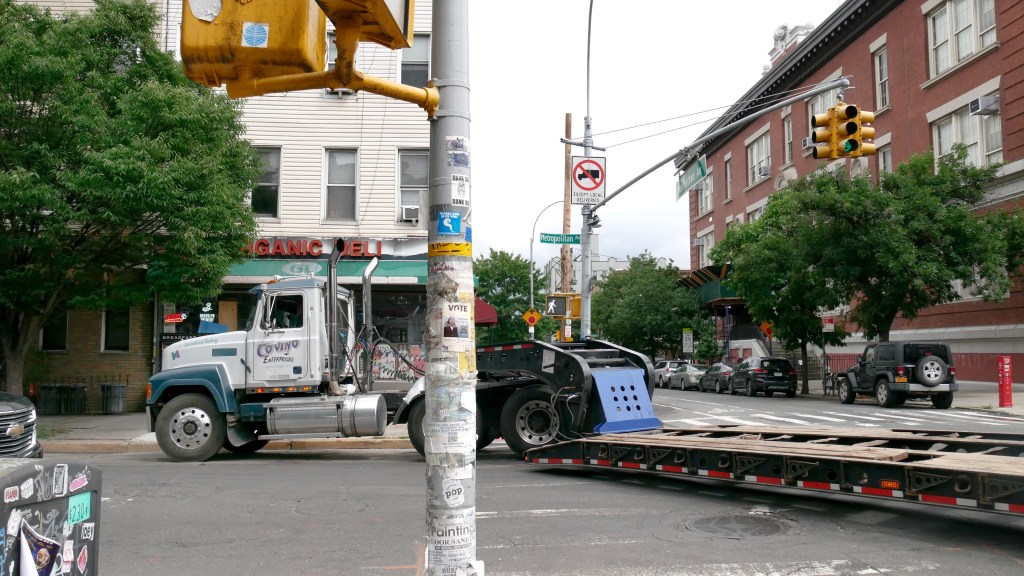
As New York’s thirst for swift deliveries surges, City Hall’s efforts to redesign truck routes have sparked an unexpected row over the trade-offs—both intended and accidental—of ferrying millions of packages through neighbourhood streets.
A box truck rumbles down a residential Brooklyn street, its air brakes hissing, as a cyclist and a toddler’s stroller squeeze past. Scenes like this illustrate how, despite decades of fretful policymaking and well-intentioned legislation, New York City remains beset by big rigs in places that seem ill-suited for their bulk. The city’s latest attempt at change has, paradoxically, magnified the very headache it hoped to soothe.
Earlier this week, Council Member Alexa Avilés (D–Sunset Park) took to the mic outside City Hall—flanked by advocates and delivery drivers—to demand fewer trucks on New York’s crowded streets. Her 2023 bill, which required officials to rethink the city’s half-century-old truck route map, was meant to corral heavy haulers onto suitable arteries and away from vulnerable neighbourhoods. Instead, the city’s preliminary response—a proposal to add 43 miles to the network—has rattled residents who had hoped for the opposite.
The confusion springs from a revealing mismatch: the city’s logistical infrastructure, last redrawn during the Nixon administration, has become outmoded by an explosion of online shopping. Today, some 90% of goods entering New York make their final hop by truck, feeding an average 2.3 million deliveries per day—a figure up sharply from 1.8 million before the pandemic. “We did not intend for more truck routes,” Ms Avilés acknowledged, voicing a frustration now familiar to those who tinker with the city’s regulatory machinery.
For the Mamdani administration, the expansion is less about catering to truckers than preventing an already-inevitable convoy from veering onto ever more unlikely streets. By mapping official routes where trucks are, de facto, already travelling, officials hope to improve predictability and allow the police to focus enforcement. Yet critics, including Ms Avilés herself, scent bureaucratic overreach and worry that more mapped routes could simply normalize the sight of 53-foot trailers trundling past brownstone stoops.
The debate is less arcane than it may seem. New Yorkers’ appetite for same-day and next-day delivery is insatiable, and industry has responded with gusto. Since 2018, at least 21 new “last mile” warehouses have materialized in Brooklyn, Queens, the Bronx and Staten Island, pulling waves of trucks ever closer to residential doors. Manhattan now boasts the highest concentration of parcel deliveries per square mile anywhere in America.
This logistical escalation has clear costs. Noise, diesel exhaust, road danger, and double-parked lorries are daily realities, particularly in working-class neighbourhoods adjacent to depots. For every step City Hall takes to tame truck traffic via new routes or expanded enforcement, the unseen hand of online retail seems poised to undo it, mouse click by mouse click.
There is, in theory, an alternative path—one that would, as planners like to say, “decouple growth from congestion.” Other cities have experimented with new freight modalities, and New York has tiptoed toward them. The city opened its first “blue highway” maritime freight pilot in late 2025, aiming to shift some cargo from streets to waterways. Elsewhere, a handful of Department of Transportation “microhubs” aggregate deliveries for transfer to smaller cargo bikes.
Early results border on the tepid. Streetsblog, a local transportation watchdog, recently observed delivery vans flouting these microhubs, sometimes paid for by their own corporate parents. The city’s pilot maritime route, which looks promising on a map, is in its infancy. Industry, for its part, may still be weighing if electrified bikes or barges can truly rival the convenience and cost of a diesel box truck idling at the kerb.
The law of unintended consequences
The conundrum faced by New York’s officials is not unique. London, Paris and other global cities also grapple with the appetite for rapid delivery—an appetite rarely sated without collateral traffic. Some European metropolises enforce stringent exclusion zones, cordoning off entire quarters from larger vehicles. Success has proven mixed; such zones are only as effective as their enforcement, and may simply displace traffic to adjacent areas.
Economically, the situation portends headaches as well as opportunity. “Last mile” logistics have created jobs, supplied New Yorkers in lockdown, and are likely to persist regardless of route maps. Yet the costs—congestion, lost curb access, and road wear—remain socialised and disproportionately borne by the city’s poorer neighbourhoods. The coincidence of record deliveries and higher asthma rates in places like the South Bronx is unlikely to escape political notice for long.
Indeed, New York’s political class now risks falling into a familiar trap: legislating complexity in hopes of simple outcomes. Mapping new truck corridors may provide the illusion of control but seems unlikely to shrink aggregate truck mileage—a finding supportable by the city’s own analysis. Without bolder experimentation, whether with river freight, stricter curb regulations, or meaningful support for zero-emission vehicles, City Hall may merely swap one inconvenient symptom for another.
We reckon there is promise, if not panacea, in a genuinely multi-modal strategy that blends regulatory carrot and stick. New York would do well to borrow from best practices abroad: time-windowed deliveries, robust fines for street violations, and—crucially—passing the cost of congestion onto the actors who generate it, large e-commerce outfits included. Otherwise, the city risks being outpaced by the very economic dynamism it prizes.
In the end, the peculiar row over truck routes offers a lesson in unintended consequences. In a metropolis where billions of dollars of goods flow daily under, over, and through dense neighbourhoods, small shifts in regulation ripple widely. Mapping a few dozen new truck-miles is unlikely to halt the march of delivery vans or restore quiet to anxious corners of Brooklyn. A lasting solution will require something far rarer in city government: the willingness to rethink both carrot and stick, and to challenge the premise that more and faster deliveries should define urban progress.
For now, New Yorkers must reconcile themselves to the oddity of a reform that may have fortified the very menace it set out to tame. The boxes will keep coming; the city’s job is to ensure that their passage does not trample all that makes New York worth delivering to. ■
Based on reporting from Streetsblog New York City; additional analysis and context by Borough Brief.