Albany Braces for Federal Cuts, Hochul Eyes Corporate Taxes as 2026 Election Looms
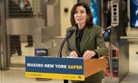
Federal retrenchment and political brinkmanship threaten to turn New York’s 2026 legislative session into a bruising contest over taxes, health care, and the state’s social contract.
In the corridors of the State Capitol, number-crunchers eye spreadsheets with growing anxiety. Looming at the top of every page is an inescapable total: over $3.75 billion in fresh fiscal shortfalls, a direct consequence of Washington’s dwindling largesse to New York. As the legislative session approaches, Governor Kathy Hochul and lawmakers find themselves navigating a precarious budgetary landscape, squeezed on one side by Medicaid cuts and on the other by gnawing political pressures from both progressives and conservatives.
The roots of this fiscal squeeze are as prosaic as they are punishing. President Donald Trump’s One Big Beautiful Bill Act, passed in the teeth of partisan acrimony, has resulted in a $750 million gash in the current year’s accounts and portends another $3 billion in losses for 2026, largely via Medicaid trims. Faced with this, Governor Hochul has flickered between fiscal prudence and political survival, vowing not to raise income taxes—an olive branch to restive middle-class voters—even as she entertains lifted levies on corporations, a decision likely to irk business leaders while providing only a tepid balm for budget wounds.
The health care blow lands heaviest among the most vulnerable. An abrupt $7.5 billion federal reduction to New York’s Essential Plan, the state’s main program offering no-premium insurance to low-income residents, has led Hochul to roll back coverage expansions. This technical fix preserves some federal support for legal noncitizens—required by a 2001 court ruling—but leaves some 450,000 New Yorkers, previously covered under the plan’s broader reach, newly uninsured. The predictably perverse result: safety net hospitals, perennial strugglers, will absorb larger bills for uncompensated care, almost certainly returning to Albany cap-in-hand for further state support.
Nor does the pain end there. Tweaked Medicaid eligibility rules threaten to knock more New Yorkers out of coverage just as hospitals face rising emergency costs. For a state priding itself as a progressive bastion, New York’s threadbare safety net may run perilously thin, at least for the coming year.
The ripple effects extend beyond health care. In an election cycle bristling with intensity, Governor Hochul confronts a pincer movement. She faces a progressive challenger in the Democratic primary—no small threat in a party increasingly skeptical of consensus-seeking centrists—while also girding herself against a Trump-aligned Republican challenger in the general. State legislators, meanwhile, confront their own skirmishes: defending seats against both left and right, steeling for contests that may punish any who flinch at the wrong shibboleth.
Albany’s instinct in uncertain electoral times is usually to shun controversy. Yet the year’s mix of fiscal shortfall and political polarisation, amplified by social media histrionics and fevered grassroots activism, means leaders may find prudence in short supply. Mayor-elect Zohran Mamdani adds further volatility. With an insurgent pedigree and broad progressive backing, he is expected to push for ballooning city investments in social programmes—a stance at odds with belt-tightening in Albany.
Balancing political perils and fiscal realities
The state’s fiscal dilemma is hardly unique. Across America, blue states are confronting the aftershocks of pandemic-era federal aid withdrawal and conservative retrenchment in Washington. California, too, faces deficits, albeit with fewer structural handcuffs than New York’s health care mandates. Yet the Empire State’s distinctive legal obligations—especially its court-mandated insurance for around half a million noncitizens—portend a thornier path.
The political consequences could prove lasting. If New York’s leadership fails to defend services, voters may punish Democrats at both the state and city levels. The progressive wing, sensing betrayal over health care, could splinter further; moderates, if forced into unpalatable tax hikes, may find themselves outflanked by business-backed Republicans eager to resurrect the canard of New York’s business unfriendly climate.
The prospect of raising corporate taxes might appear palatable in campaign debate, but experience suggests caution. New York City’s job growth remains puny compared with pre-pandemic exuberance, and corporate departures—murmured, not yet manifest—could accelerate if fiscal drag grows heavier. Those tax rises, then, may be more symbolic than solvent, as firms can, and often do, relocate to states with lighter burdens or friendlier regimes.
On some level, the entire Albany imbroglio underscores the peculiar vulnerabilities of America’s federal system. State coffers, lashed to the whims of Congress and White House, must adapt repeatedly to shifting priorities emanating from Washington. Federal Medicaid cuts may be reshuffled, reversed or deepened depending on which party controls the capital after 2024, rendering long-term planning for the states closer to crystal-ball gazing than genuine budgeting.
If one looks abroad, the contrast is illuminating. European peers—say, Germany or Sweden—insulate local social spending with more secure national guarantees and formulaic funding. New York’s perennial dance with federal unpredictability remains, in global comparison, oddly precarious for a state of its size and economic heft.
What then should one make of Albany’s coming battles? Governance in New York has always demanded bravura: fiscal jugglery, political brinkmanship, and a capacity for improvisation when the federal government proves fickle. We reckon the 2026 session will see a familiar spectacle—grandstanding, a flurry of last-minute budget deals, and no shortage of calls to “complete the safety net.” The outcome, almost certainly, will be a patchwork. Yet if city and state leaders can thread the needle—protecting the genuinely needy, avoiding punitive tax increases, and resisting short-term posturing—New York may yet emerge only bruised, not broken. ■
Based on reporting from City & State New York - All Content; additional analysis and context by Borough Brief.